Is AI making students lazy? What the research says, and what actually helps
Short answer: it depends on what the AI does for them.
When AI does the thinking, students do less of it, and research now shows they learn less. When AI makes students do the thinking, with hints, questions and fresh practice, it can be one of the best study helpers they have ever had.
So the useful question is not "AI or no AI?" It is "What is the AI doing for my child?"
The experiment every parent should know about
Researchers at the University of Pennsylvania ran one of the largest real-classroom AI studies so far, with nearly 1,000 high-school math students in Turkey. It was published in PNAS, one of the top science journals, in 2025.
Students practised math in three groups. Then they all wrote an exam without AI.
| Group | During practice | On the exam (no AI) |
|---|---|---|
| Textbook and notes only | Starting point | Starting point |
| Ordinary AI chat | 48% better | 17% worse |
| AI built to guide, with hints instead of answers | 127% better | About the same as no AI |
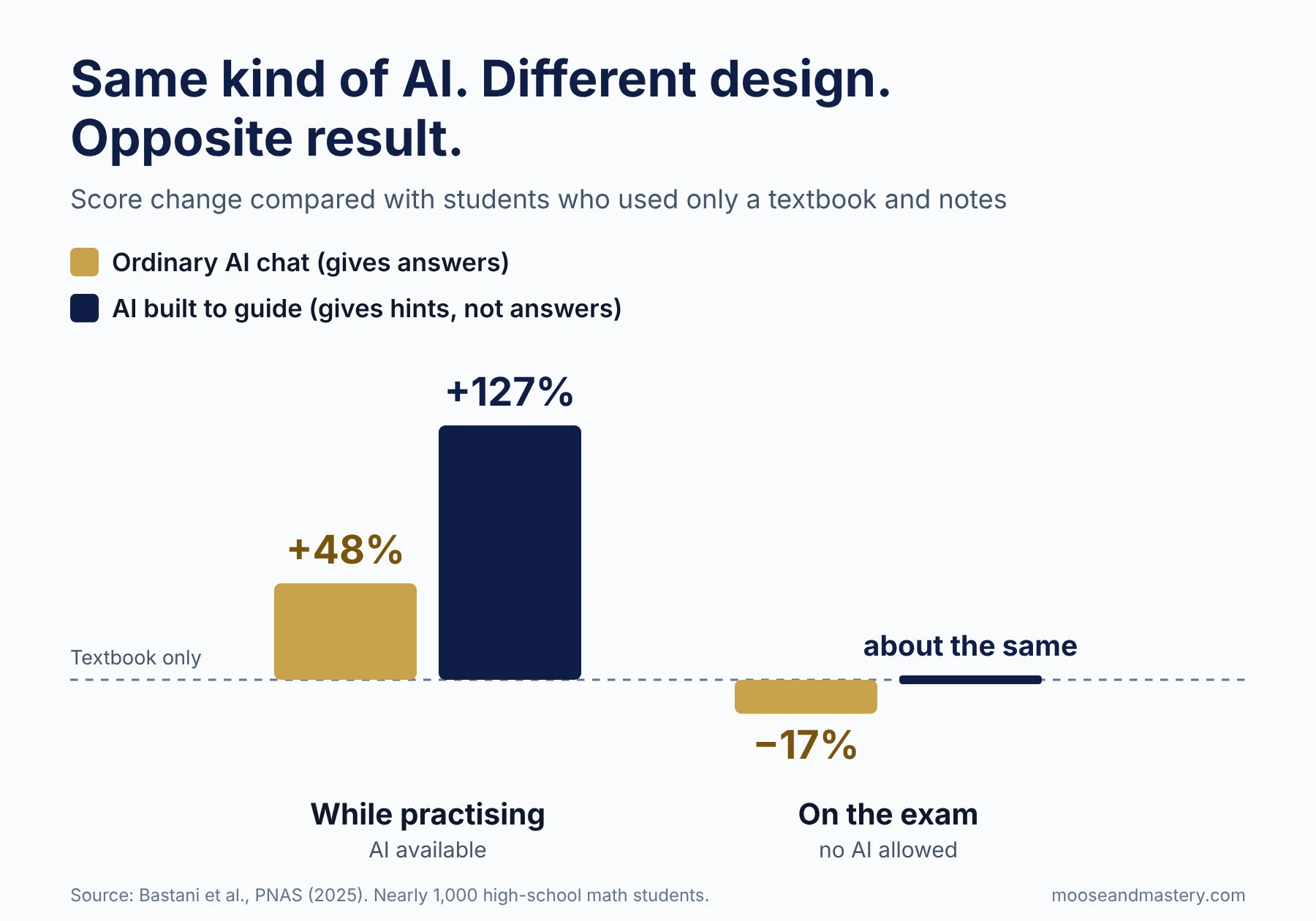
Three things stand out:
- The ordinary AI made practice look great and learning worse. Those students scored higher while the AI was there, then lower once it was gone.
- Students could not feel it happening. The researchers found students who used AI were too optimistic about how much they had learned.
- Design changed everything. The guided version used the same kind of AI. Because it gave hints instead of answers, the harm largely disappeared.
One honest note: even the careful AI did not raise exam scores above the textbook group. Good design removed the harm. The learning still came from the student's own effort.
Why "too easy" help stops learning
Think of a gym. If someone else lifts the weights for you, the weights still go up, but your muscles do not grow.
Learning works the same way. Memory researchers call it desirable difficulty: the effort of pulling an idea out of your own head, getting it wrong, and fixing it is what makes it stick. Remove the effort and you remove most of the learning.
That is why the most dangerous words in a math class are "I understand." Reading a clear solution feels like understanding. But following someone else's steps and producing your own are two different skills. Tests only measure the second one.
A small early study from the MIT Media Lab points the same way. Adults who wrote essays with an AI chatbot showed the weakest brain engagement of three groups, had trouble quoting their own essays afterwards, and felt the least ownership of their work. It was only 54 people and not yet peer reviewed, so treat it as a warning sign, not a final answer.
What is happening in Canada
AI is already part of school life here:
- 75% of Canadian students aged 18 and over use generative AI for schoolwork, and 51% of them say their critical thinking has gotten worse since they started (KPMG Canada, 2026).
- 62% of educators in the same survey list students' over-reliance on AI among their top worries, and 77% say AI has already changed how they assess learning.
- In a Fraser Institute survey of Grade 6 to 12 teachers, 95.6% believe at least some of their students use AI for homework, and 78.6% say some students' in-class work is weaker than their take-home work.
Put simply: a homework mark is becoming a weaker signal of what a student can really do.
One problem, two kinds of help
Here is the same Grade 9 or 10 question, helped two ways.
Solve:
Help that gives the answer:
"Expand the brackets to get . Subtract from both sides: . Add 6: ."
The student copies it down. Homework done. Nothing was practised.
Help that gives a hint:
- Hint 1: "What can you do with the 3 in front of the brackets?"
- The student multiplies it in and writes .
- Hint 2: "Can you get all the terms on one side?"
- The student writes , so .
- Check: and . Both sides match.
Both students end with . Only one of them can do the next problem alone.
Warning signs that AI is doing the thinking
Watch for these, especially together:
- Homework is near perfect, but tests are not.
- They cannot explain a step in their own words.
- They finish very fast, but freeze on a similar question without a screen.
- "I understand" turns into a blank page when the numbers change.
- They panic or stall when the AI is not available.
None of these means a child is lazy. It usually means the tool is making things too easy.
How to use AI so students get stronger
For students
- Try first. Give a problem at least a few honest minutes before asking for help.
- Ask for a hint, not the answer. One step forward is enough.
- Explain it back. If you cannot say why a step works, you do not own it yet.
- Redo a similar problem with no help. This is the real test.
- Check the AI. General AI chatbots can sound sure and still be wrong, especially in math.
For parents
- Ask "Show me how" instead of "Are you done?"
- Try the cover-up test. Cover the solution and ask your child to solve a similar question while you watch.
- Compare homework with tests. A growing gap is worth a calm talk with the teacher.
- Do not ban AI. Help your child use the kind that makes them think.
For teachers
- Make thinking visible with short in-class checks and "explain your step" questions.
- Use fresh versions of questions so copied answers stop helping.
- Allow hints during practice, assess without them.
- Look at progress over time, not one perfect assignment.
Four questions to ask about any AI study tool
- Does it give hints, or does it hand over answers?
- Is the math checked, or generated on the spot?
- Does it match what the student is learning in their actual course?
- Does it lead to practice afterwards, so the student proves they can do it alone?
If the answer to most of these is no, the tool is built for finishing homework, not for learning.
How we built Moose & Mastery around this
We built Moose & Mastery because of exactly this problem. It is an AI learning assistant for students and a teaching assistant for teachers, designed to keep the thinking with the student.
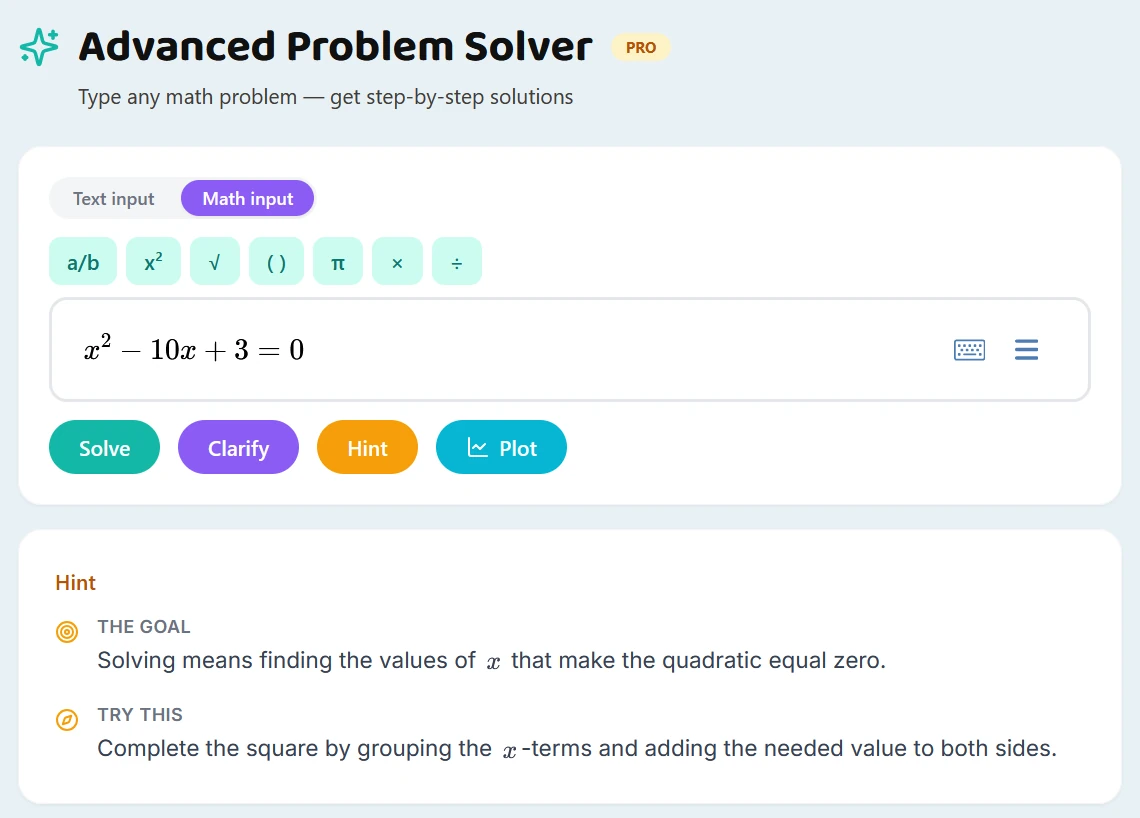
A real hint from the app: the goal and a next step, not the answer.
- Hints instead of answers. Students can ask for a hint rather than the full solution, and hints are checked so they never contain the final answer.
- "What is this asking?" explains the wording of a question in simpler language, without solving it. This helps students who know the math but get stuck on the English.
- "Practice similar questions" gives fresh questions on the same lesson, at the same level, so a wrong answer becomes practice, not a dead end.
- Verified math. Student practice comes from a math library reviewed and verified by qualified math teachers and aligned to the BC curriculum.
- The teacher stays in the loop. Teachers choose and assign the work and see the results.
An AI made FOR education, not just a general AI IN education.
The bottom line
AI is not making students lazy. AI that does the work for them is. The same technology that can weaken learning can also strengthen it, when it is built to guide instead of answer. The goal is not to keep students away from AI. It is to make sure they can still do the math when the AI is gone.
Sources
- Generative AI without guardrails can harm learning: evidence from high school mathematics (PNAS, 2025)
- Without guardrails, generative AI can harm education (Knowledge at Wharton)
- Majority of students use AI, but educators sound alarm (KPMG Canada, September 2026)
- Survey of Canadian Grades 6 to 12 teachers on AI use (Fraser Institute, August 2026)
- Accumulation of cognitive debt when using an AI assistant for essay writing (MIT Media Lab, 2025 preprint)
Try it free
Moose & Mastery is a safe AI assistant for math teachers, tutors and students.